
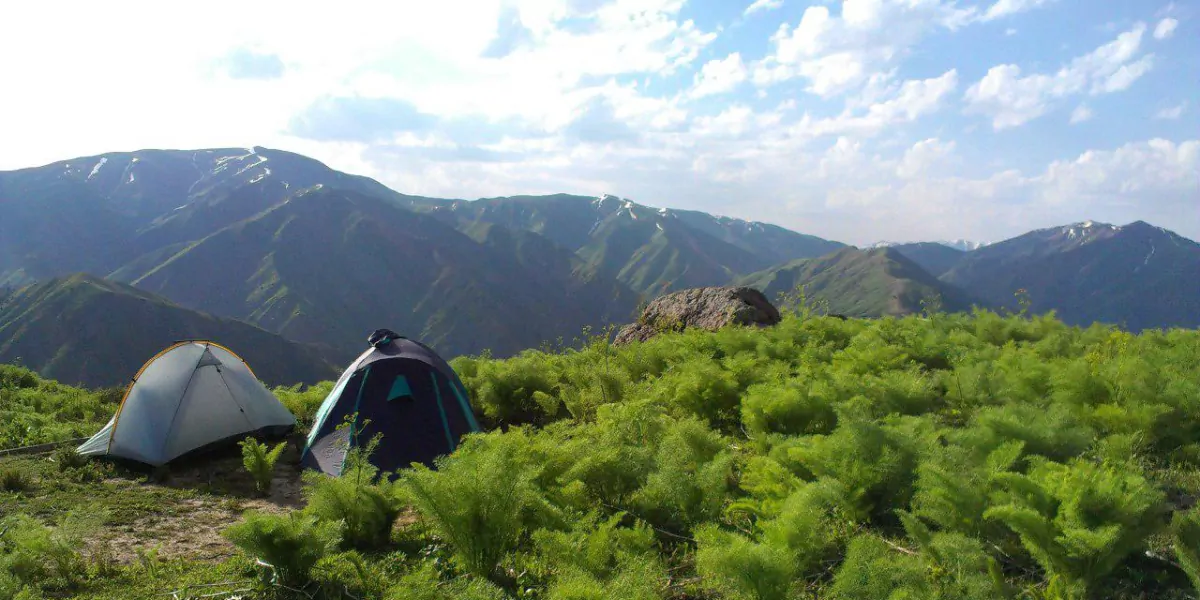
Orchards and mountains of the Silk Road

Ohalik Experiences

Gardens of the Silk Road

At a gardener's pace, from the cultivated oasis to the wild source.

A 16-day journey through Uzbekistan & Kyrgyzstan Uzbekistan & Kyrgyzstan

About this journey

Central Asia is not where garden style was invented — it is where the plants themselves come from. The wild tulips of the Tien Shan are the ancestors of every tulip in Holland; the fruit-and-nut forests of these mountains gave the world the apple, the walnut and the apricot; and Timur's fourfold chorbagh gardens in Samarkand are the grandparents of the Taj Mahal's. Sixteen days through two countries: Uzbekistan, the cultivated oasis, and Kyrgyzstan, the wild source — travelling with botanist Dr Uken Myrzabekova of the Kyrgyz National University, at a gardener's pace, with almost every day ending around a table in a garden. Two departures, two different journeys: spring for blossom and wild tulips, autumn for the harvest.

The journey, day by day

Day 1 — Tashkent: A Capital of Plane Trees

The first thing you notice about Tashkent is the shade. The afternoon opens in the Botanical Garden of the Academy of Sciences, where your expert introduces the cast of the whole journey — the wild ancestors of tulip, apple, walnut and apricot — then moves through the Japanese Garden to the seed rows of Chorsu, where grandmothers sell basil and marigold seed by the glassful.

At a glance

Day 2 — To Bukhara: From Cotton to Orchards

One generation ago this field grew cotton; today it grows peaches, and the farmer will tell you why. The high-speed train crosses the steppe to Bukhara, and after the Poi Kalyan and the trading domes we drive out to a family orchard planted on old cotton land — one of the great agricultural stories of our time, told plainly, with the thin-skinned Bukhara lemon to taste.

At a glance

Day 3 — Bukhara: The Biologist, the Gardens of the North, and Cotton

Cotton is not a villain here; it is a family member with a complicated history. Tea at the home of a Bukharian biologist opens the question of how a desert city fed itself for two millennia. Then a working day with cotton farmers in the northern garden belt, and an afternoon among the roses and peacocks of the last Emir's summer palace.

At a glance

Day 4 — To Samarkand: Grapes of the Royal City

Samarkand's grapes were praised by Chinese envoys thirteen centuries before anyone praised its architecture to you. We drive straight from the station into vineyard country — Kishmish, ancestor of the sultana; Husayni, the lady-finger of the courtyard trellis — then the historic Khovrenko winery, founded 1868, with a tasting. At dusk, the Registan turns its tilework to fire.

At a glance

Day 5 — A Timurid Garden Day

Six hundred years ago this was the best-gardened city on earth; today is spent inside that memory. Mulberry-bark paper pressed by your own hands at Konigil, suzani embroidery in Urgut — a garden in thread, stitched by brides — and in the evening a chorbagh feast on carpets among the trees, plov over fire, wine poured, and Ulugbek's stars overhead when the lights go out.

At a glance

Day 6 — Village and Mountain: Amankutan

The forest on this pass was planted by hand, tree by tree, and the village remembers who planted it. A day hosted in a mountain village house: a botanical walk through the nineteenth-century woodland, bread baked in the tandoor, a long lunch under the apricot trees. In the evening, the comfortable train north to Tashkent.

At a glance

Day 7 — The Fergana Valley: The House of the Grape Master

In the Fergana Valley a courtyard without a vine trellis is considered an unfinished house. Through the Kamchik pass into the greenest landscape between China and the Caspian, and an afternoon in the courtyard of a master grape gardener — how vines are buried each winter and raised each spring, which varieties his grandfather kept, and which he has added. Neighbours join for tea.

At a glance

Day 8 — Flowers in Silk and Glaze, then Across the Border

Before leaving Uzbekistan we see its gardens one last time: woven into ikat silk at Margilan and painted onto Rishton's cobalt plates — gardeners read these patterns instantly; they have been reading them in borders all their lives. After lunch we walk across the Dostyk border into Kyrgyzstan and climb Sulaiman-Too, the sacred mountain of Osh.

At a glance

Day 9 — Osh to Arslanbob: Into the Walnut Mountains

Every walnut tree in every garden on earth has family in the forest we sleep beside tonight. North through Uzgen, where the red devzira rice grows and the eleventh-century minaret still stands, then up into Arslanbob — the largest natural walnut forest on earth, with wild apples and pears growing beneath the canopy. Legend says Alexander carried these walnuts to Greece.

At a glance

Day 10 — Arslanbob Forest, then the Shores of Toktogul

You leave Arslanbob the way you leave a grandparent's orchard: with your pockets full. A forester walks you among the ancient trees to the waterfall — each family here holds hereditary rights to its own trees, an orchard tenure centuries old — and you taste honey from hives that stand among the walnuts. Then down to the turquoise water of Toktogul.

At a glance

Day 11 — The Kökömeren Canyons to Kochkor

Some landscapes cannot be gardened. They can only be witnessed. The great wilderness traverse of the journey follows emerald water through towering red-rock canyons, with Dr Myrzabekova reading the canyon flora as we go. We stop with a beekeeping family for white Suusamyr honey among the hives, picnic by the river, and arrive by evening in Kochkor, homeland of Kyrgyz felt.

At a glance

Day 12 — Kochkor Felt Gardens, then Issyk-Kul

A shyrdak carpet is the nomad's garden: flowers cut in felt, so spring can live inside a yurt through winter. A hands-on morning with the women's felt cooperative — you roll, cut a motif, and take your piece home — then over the ridge to Issyk-Kul, the world's second-largest alpine lake, and a walk among three-thousand-year-old petroglyphs above the shore.

At a glance

Day 13 — Semenovsk Gorge and the Eagle Hunters

The alpine meadow is the oldest garden style on earth, and nobody planted it. A morning walking the flower-rich meadows of Semenovsk Gorge at a gardener's pace — the original of which every naturalistic planting is a copy, interpreted by the professor who teaches its systematics. In the afternoon, a berkutchi flies his golden eagle, and you feel the wind of her wings.

At a glance

Day 14 — Burana Tower and on to Bishkek

A minaret alone in a field of steppe grass and poppies: the Silk Road, edited down to one image. Down through the Boom Gorge to Burana, all that remains of the Karakhanid capital of Balasagun — and there is a poetry here: Dr Myrzabekova's university carries Balasagun's name, and today she reads the steppe flora of the city itself. Bishkek by late afternoon.

At a glance

Day 15 — Bishkek and Alpine Ala-Archa

In the morning, a green Soviet garden city; in the afternoon, the mountains that supplied every plant in it. Bishkek's oak parks and street trees first, then Ala-Archa National Park, forty minutes away, where a gentle river walk carries you among four-thousand-metre peaks. A farewell dinner closes the circle the botanical garden opened fifteen days ago.

At a glance

Day 16 — Departure

Individual transfers to Manas airport for your onward flights — or stay: extra nights in Bishkek, a return through Tashkent, or a private extension are all easily arranged. You leave with seeds of another kind: the memory of the wild originals, growing exactly where they have always grown.

At a glance

Come With Us

Begin this journey

Write to us with your dates and what most draws you, and we will write back, by hand, within two working days.

Write to info@ohalik.com Let's connect

Let's Connect

Pick a time that suits you — you'll be talking with Samir, who has driven, walked, and slept on every route we sell.