Day 1 · Tashkent
Arrival. Transfer to the hotel. Tea at a chaikhana in Chorsu, where the city wakes up. A light dinner with the guide, who lays out the journey ahead.
The first slow breath after a long flight.
 OHALIK
Ohalik Experiences
Stones, stories, and the people who keep them.
Central Asia has been called many things by people who passed through quickly. The Silk Road. The crossroads of empires. The forgotten quarter of the old world. None of those names belong to the people who live here. We call the places by the names our grandparents used: Buxoro, Samarqand, Xiva, Tirmiz, Khujand, Marv. Each one is a city the same age as Rome, with a longer memory and fewer plaques.
A cultural heritage journey with Ohalik is not a march from monument to monument. We move slowly. We sit with the people who restore the tiles, recite the ghazals, and bake the bread the same way their mothers did. We knock on doors that do not advertise. We bring you to the workshop of a coppersmith in Bukhara who is the fifth generation of his family at the same anvil. We bring you to the home of a Tajik widow in old Samarkand who serves osh on a cloth her grandmother embroidered in 1948.
These trips are made for travellers who want to understand, not only to see. You will not be rushed. You will not be served a script. Your guide will be a friend of ours, often a literature graduate or a former museum curator, who can read the Persian inscriptions above your head and tell you why they matter. We do not put you in places that serve plov to a hundred tour groups a day. We sit you at a table set for eight.
Architecture of the Timurid and post-Timurid era. The Silk Road as it was actually lived, not as the marketing brochures describe it. Sufi shrines and their living traditions. Crafts still practised by hand: silk weaving in Margilan, ceramics in Rishtan and Gijduvon, suzani in Nurota, miniature painting in Bukhara, carpet knotting in Samarkand. The poetry of Navoiy, Rumi, Hafez, and Ferdowsi, read aloud in the cities where it was written. The Jewish, Zoroastrian, Buddhist, and Christian layers that lie beneath the Islamic surface.
Arrival. Transfer to the hotel. Tea at a chaikhana in Chorsu, where the city wakes up. A light dinner with the guide, who lays out the journey ahead.
The first slow breath after a long flight.
Hazrati Imom complex and the world's oldest Quran. The Museum of Applied Arts. Private lunch with a third-generation ceramic family in the old town. In the late afternoon we fly west to Nukus, capital of Karakalpakstan. Rest at the hotel, an early dinner.
The city that was rebuilt twice and still remembers.
A full day in the remote village of Chimbay, in the heart of Karakalpakstan, where the steppe runs to the horizon and the old Aral wind still moves over the houses. Our host, a friend who has lived here all his life, walks us through the lanes himself. He opens the doors that do not open to strangers. We sit with felt-makers and bread-bakers. We meet the elders who still remember the Aral when it was a sea. We eat at the family table.
The village that takes you in.
Morning at the Savitsky Museum, the second-largest collection of Soviet avant-garde painting in the world, kept alive in the desert by a man who hid the canvases the state wanted destroyed. After lunch we drive south along the Amu Darya, with a stop at Chilpyk Kala, the Zoroastrian tower of silence above the river, and a brief pause among the desert fortresses of ancient Khwarezm. Arrival in Khiva by evening, into the lamplight of Ichan-Qala.
The museum that should not exist, in the city no one expected.
A slow morning in the Juma Mosque, where two hundred and twelve carved wooden columns hold the ceiling. Visit to a suzani embroiderer who works for the museum. An afternoon for tea and walking the old city at your own pace. Evening with a local musician playing dutar in his courtyard, by lamplight.
The hands that hold the old songs.
We take the new high-speed train across the Kyzylkum desert, the same crossing the camel caravans made in fourteen days and that we now make in a single ride. Tea on board. The window framing the long view of the steppe. Arrival in Bukhara in the afternoon, with time for a first slow walk through the old town before dinner.
The road the camels walked, in modern carriages.
Dawn walk through Lyabi-Hauz before the bazaar opens. Poi Kalon ensemble at the soft hour. Lunch in the studio of our friend Zarnigor, a calligrapher's daughter. In the afternoon, a slow walk through the trading domes of Bukhara, where the silk merchants, the jewellers, and the hat-makers have kept their stalls for five hundred years.
The city that was a synonym for learning.
The Ark and the Bolo-Hauz mosque in the morning. Chor-Bakr necropolis in the afternoon, where four Sufi sheikhs lie under a sky of swallows. Evening at leisure.
Prayer and dust and pigeon wings.
A late morning coffee with a friend who teaches at the local university. If the timing allows, we walk the campus together, and he speaks honestly about what education in this country has been, and what it is becoming. After lunch, the high-speed train carries us east to Samarkand. Evening arrival, settling in at our family hotel.
The conversation that is not in the brochure.
Registan in the morning, when the light is still cold. Shah-i-Zinda before the heat. Lunch in the Jewish quarter, in the home of a family whose grandparents have lived in this lane since the war. Afternoon at Ulugbek's observatory. Evening tea at Siyob bazaar with a bread baker who has worked the same tandyr for forty years.
Three madrasahs and the hands that baked the morning bread.
A thirty-minute drive out of the city brings us to Ohalik, the village that gave our company its name. The morning belongs to Mahbuba, who has the lightest hand with patir bread that we know. We knead the dough on the wooden board on the floor. We light the tandyr with grapevine cuttings, the way her mother taught her. We slap the dough against the inner wall and pull the bread out twelve minutes later, hot enough to burn the fingers. Then we fold samsa together: lamb, onion, and the herbs from her garden. Lunch is plov cooked outdoors over a wood fire by Bobur-aka, whose grandmother taught him the Samarkand cut of carrot.
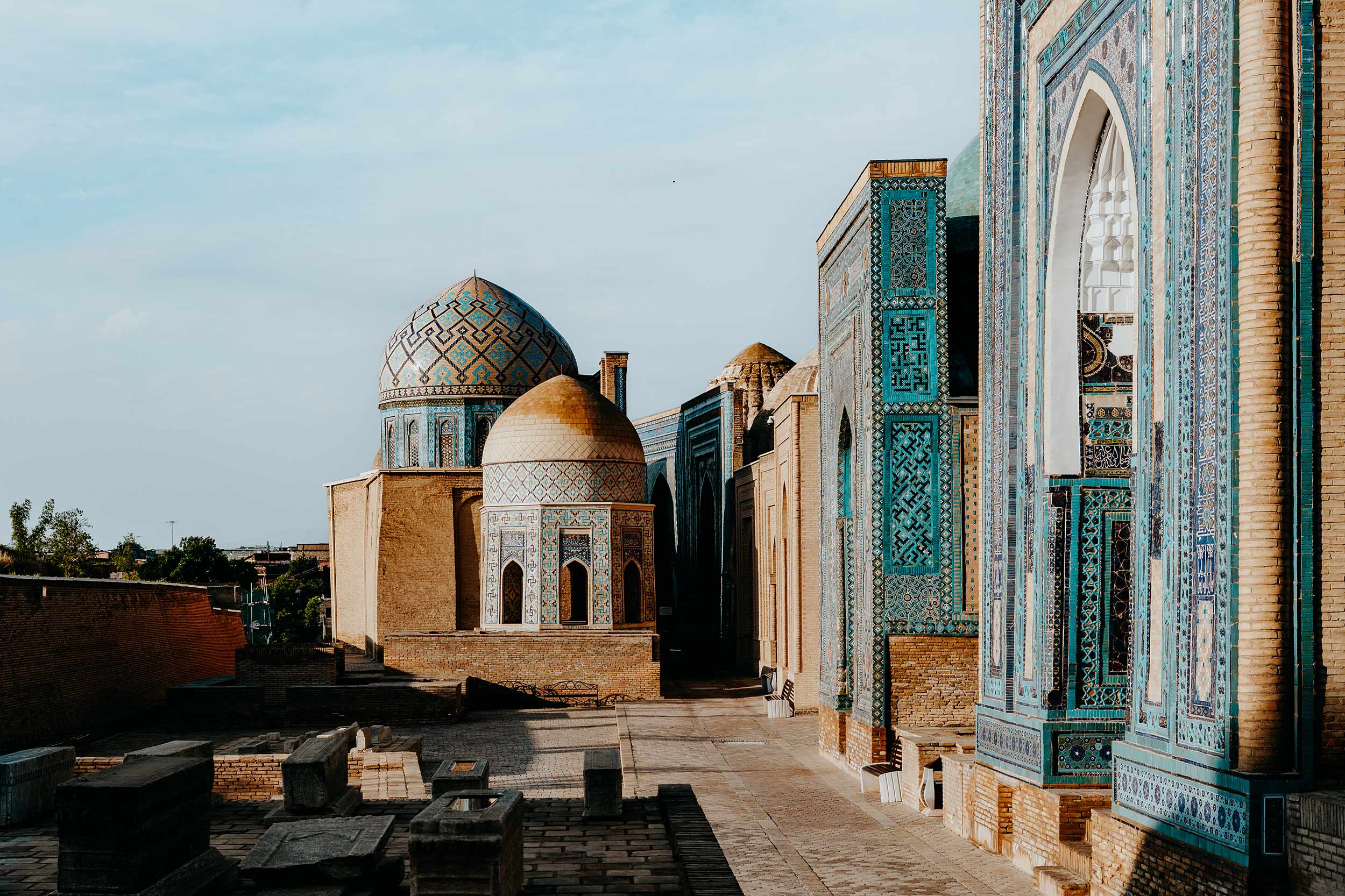
We return to the city in the afternoon for the Gur-e-Amir, the mausoleum of Tamerlane, where the blue of the dome at dusk is a colour we have no other word for. After dinner we walk back to the Registan, when the floodlights come on and the three madrasahs turn gold against the dark.
The village we are named for, and the city that names itself.
A slow walk at dawn through the lanes around our family home. A wellness hour on the terrace at Amira Boutique Hotel. Farewell breakfast in the courtyard.
For travellers flying out of Samarkand, the airport is twenty minutes away. For those flying out of Tashkent, a late afternoon high-speed train carries you there in two hours.
A goodbye that is not a goodbye, because you will come back.
Group size.We design this journey for small private parties, typically two to twelve travellers. We do not run mixed group departures.
Pace.Moderate. Most days include three to six hours on foot or in workshops. We schedule rest hours after lunch on the warmer days.
Hotels.Boutique and family-run throughout. In Samarkand, our own Amira Boutique Hotel. In Bukhara and Khiva, two or three options we have known and trusted for years. In Nukus, the best of what the city offers.
Best seasons.Late March through early June, and again September through early November. Winters are bright and cold, with very few other travellers, which some clients prefer.
Pricing.On request. Quoted per traveller against final group size, season, and hotel category. Our quote includes everything we list, and we list everything.
To begin.Write to info@ohalik.com or message us on WhatsApp. Tell us when you can travel, who you are travelling with, and what most draws you to this journey. We will write back, by hand, within two working days.
Come With Us
Write to us with your dates and what most draws you, and we will write back, by hand, within two working days.
The full itinerary, to your inbox
Tell us where to send it and the complete day-by-day PDF — route, people, meals, practical notes — arrives in your inbox a moment later.